Crypto stocks. We may be headed full-on to a Snow Crash cyber-punk future with no long-term personal relationships and digital value embedded in all of us directly correlated to the value provided to a society that increasingly devalues humanity. This may be the point in time that needs to be stopped from going forward by some future being.
Burry on tokenized stocks: don't open that door
Burry warned on May 19 that the SEC's tokenized-stock plan risks a Snow Crash cyberpunk future — the SEC then delayed the plan on May 22.

Michael Burry (Scion Asset Management, best known for his 2008 subprime short chronicled in Michael Lewis's The Big Short) published a public Note on his Substack Cassandra Unchained on May 19, warning that the SEC's plan to let crypto platforms trade tokenized versions of U.S. stocks could set off an irreversible social and financial deterioration. 1
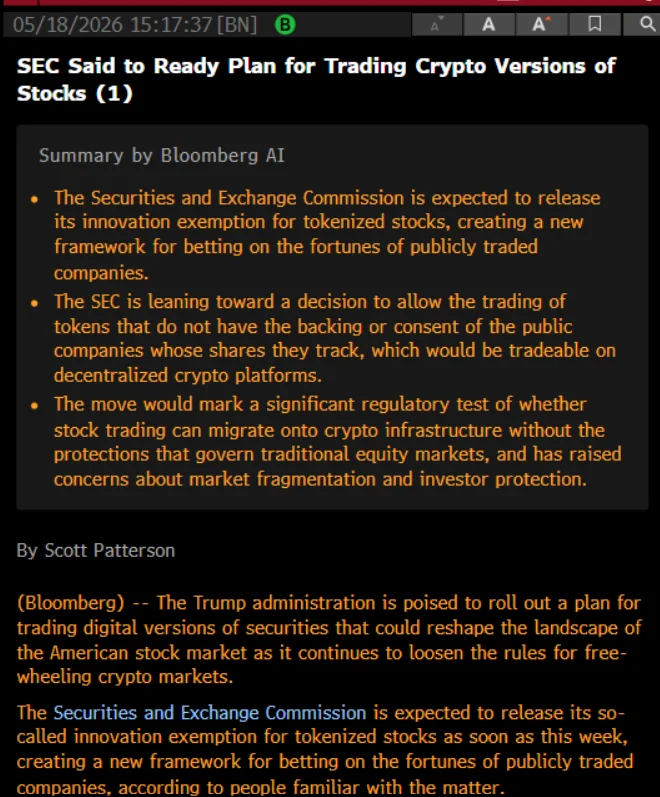
Bloomberg had reported on May 18 that the SEC was drafting an "innovation exemption" that would allow crypto exchanges to list tokenized equities on a blockchain — without necessarily obtaining the consent of the companies whose shares were being represented. 2
Burry's response was unambiguous. Drawing on Neal Stephenson's 1992 cyberpunk novel Snow Crash — in which national governments have collapsed and power belongs to corporate franchises and digital gangs — he wrote:
"We may be headed full-on to a Snow Crash cyber-punk future with no long-term personal relationships and digital value embedded in all of us directly correlated to the value provided to a society that increasingly devalues humanity. This may be the point in time that needs to be stopped from going forward by some future being." 1
In a follow-up comment, Burry distilled his concern to eleven words: "Regulators have one job. Do not open scary doors." 2
He mirrored the Note on X (tagged #snowcrash), where it drew 1,346 likes and 179 reposts. 3
コンテンツカードを読み込んでいます…
Burry's core objection is structural, not sentimental. Tokenized stocks trading on crypto rails operate around the clock, outside the circuit-breaker and settlement architecture that U.S. equity markets have built up over decades. Citadel Securities raised a parallel concern in a December 2025 letter to the SEC, warning that the plan would create a "shadow" U.S. equity market that splits liquidity and erodes investor protections. 2 Burry's Snow Crash framing goes further: he is not just worried about market fragmentation. He is worried about what the underlying logic — digital value tied directly to individual utility, companies issuing tokens without shareholder consent — does to the relationship between people and the institutions they own.
On May 22, the SEC announced it was delaying the tokenized-stock plan. 2 The delay does not close the question — regulatory proposals shelved under one chair tend to resurface under the next. For investors who hold U.S. equities or positions in crypto platforms that have been lobbying for tokenized-stock access, the SEC's eventual decision on this framework is worth tracking: it would alter how those shares trade, who can trade them, and what protections apply when something goes wrong.
This is the first time Burry has publicly addressed crypto or tokenized-assets regulation; his previous Substack work focused on AI capital concentration and software-stock valuations.
Cover image: Note illustration from Burry's Substack post. 1
このコンテンツについて、さらに観点や背景を補足しましょう。