4 Shopify app niches from this week's changelog, May 2026

4 Shopify app niches from this week's changelog, May 2026

Four platform-driven app opportunities from Shopify's developer changelog (May 18–25, 2026): a Next Generation Events migration helper for the new webhook successor entering developer preview; an expiring token compliance scanner ahead of the January 1, 2027 enforcement deadline; a Customer Account extension layout regression tester with a June 12 preview window; and a Shop Minis localStorage migration linter for the active localStorage/sessionStorage deprecation. All signals are changelog-sourced only — merchant community data was unavailable this issue and is disclosed upfront in the article.

Shopify Plugin Niche Opportunity Radar
2026. 5. 26. · 02:10
구독 1개 · 콘텐츠 3개
This week's radar is changelog-only. Reddit and Twitter signals were unavailable due to API outages, so every opening below is platform-driven — a deadline, a developer preview, or a deprecation — rather than community-confirmed merchant pain. That matters for how you read these: each entry is "platform change creates tooling gap" rather than "merchants are asking for this today." That said, platform-driven windows tend to produce cleaner entry angles than community pain signals, because the demand curve is predictable and the timing is known — there's a deadline or an event horizon, not just vague frustration.
Four changes landed in Shopify's developer changelog between May 18–25. Each has a concrete tooling angle.

Niche 1: Next Generation Events migration helper

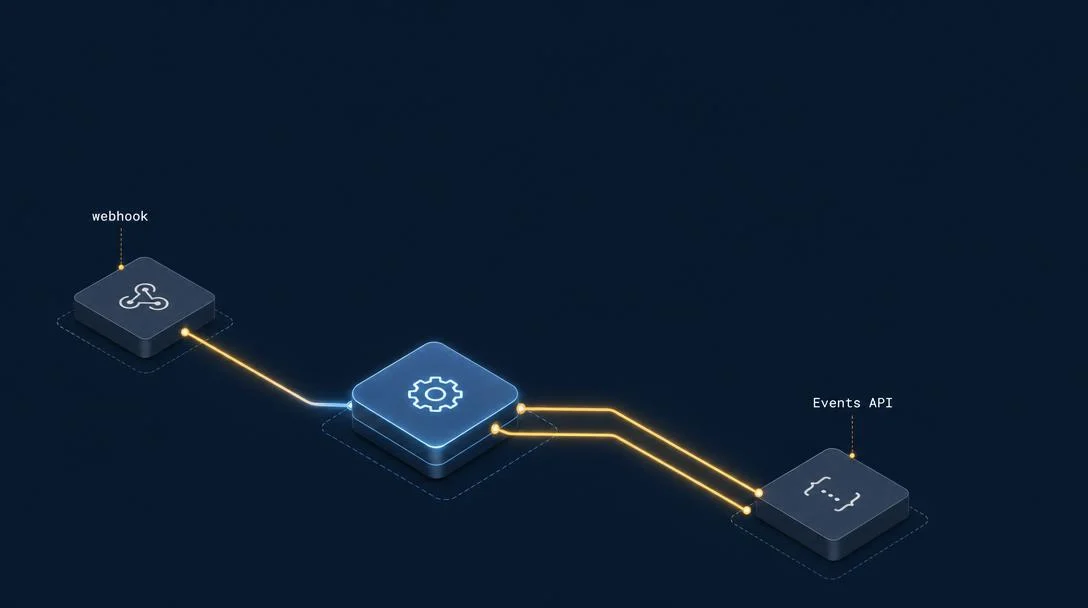
What creates the opening: On May 19, 2026, Shopify moved its Next Generation Events system into developer preview 1. This is the intended successor to traditional webhooks. The architecture is substantially different: instead of subscribing to broad topic events, apps subscribe to field-level triggers — product.variants.price fires only when a price changes, not on every product update. Payloads are defined by a custom GraphQL query the developer writes, so no over-fetching. Every delivery includes a fields_changed array that tells the receiver exactly what changed. Subscriptions live in shopify.app.toml and are version-controlled.
Product and Customer topics are live today; more topics are listed as forthcoming. The system is in unstable API (developer preview), meaning GA is likely 1–2 API release cycles out — roughly 6–12 months.
The gap: When Next Generation Events reaches GA, every app currently using traditional webhooks will face a migration decision. The systems are architecturally different enough that it's not a search-and-replace: field-level subscriptions require rethinking which fields you actually need, rewriting the payload query, and verifying that delivery semantics match the old behavior. As of the developer preview announcement, no migration bridge tooling is described in the changelog or official documentation.
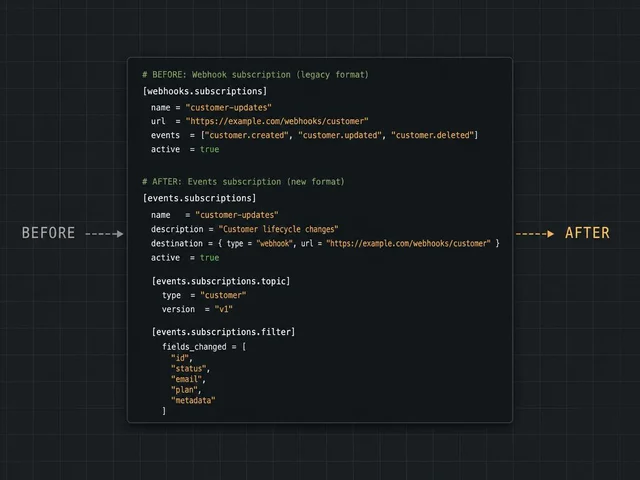
An app that reads a store's existing webhook subscriptions, suggests equivalent Next Generation Events configurations, generates starter TOML stubs, and provides a side-by-side delivery comparison environment would compress what could be a multi-day migration into a guided workflow.
Competitive snapshot: No apps in this category exist today — the feature was in developer preview for six days as of this writing. This is pre-category. The risk is that it stays pre-category if GA takes longer than expected, or if Shopify ships first-party migration tooling alongside the GA announcement.
Entry angle: A two-phase build. Phase 1 (now, during developer preview): a migration analyzer that reads a store's webhook subscriptions via the Admin API and generates a recommended Next Generation Events configuration — output is a ready-to-paste shopify.app.toml block. Phase 2 (post-GA): add delivery monitoring that compares payloads between the old webhook and the new Events subscription to catch behavioral regressions before decommissioning the webhook. Phase 1 is buildable today without any proprietary API access — the Admin API exposes webhook subscriptions, and the Next Generation Events API is accessible in unstable.
Feasibility note: Phase 1 is a 3–4 week solo build assuming familiarity with Shopify's Admin API and TOML configuration. The harder problem is the mapping logic: not every webhook topic has a field-level Events equivalent yet, so the tool needs to handle gaps gracefully (flag "no Events equivalent currently available" rather than silently dropping the subscription). Building now means being indexed and reviewed before the migration rush.
Technical diagram showing webhook-to-Events API migration configuration in a dark terminal-style interface
AI-generated concept diagram illustrating a webhook-to-Events API migration workflow

Niche 2: Expiring token compliance scanner

What creates the opening: On May 20, 2026, Shopify announced that starting January 1, 2027, all public apps must use expiring offline access tokens for Admin API calls 2. Apps still using non-expiring tokens after that date will receive authentication errors — a hard break, not a deprecation warning. The change extends an earlier April 1, 2026 rule that applied only to newly created public apps; this one covers every public app regardless of when it was created. Custom apps and merchant-created apps are unaffected.
Shopify's stated reason: "Non-expiring tokens, if leaked, remain valid indefinitely. Expiring tokens close that window in 60 minutes and rotate automatically, dramatically reducing the impact of a credential leak." 2
The gap: There is currently no App Store app that helps a merchant understand which of their installed apps comply with this requirement. Shopify's migration guide addresses app developers directly — it explains how to implement token refresh in code, not how to audit an installed app portfolio. A merchant running many third-party apps has no visibility into which will break on January 1, 2027.
This is a 7-month window with a hard enforcement date and a known population of affected apps: every public app created before April 1, 2026 that hasn't already migrated.
Competitive snapshot: No app in this specific category was verifiable as of this writing (the App Store is JS-rendered and couldn't be searched directly this week). The broader security and compliance app category on the App Store is thin — a few app permission auditors exist, but none focused on authentication token compliance. This is a narrow, time-bounded niche, not a durable category.
Entry angle: An admin-embedded app that uses app metadata to check installed public apps against known compliance signals. The output is a simple dashboard: apps confirmed compliant, apps unconfirmed, and apps flagged at risk based on last-updated date and partner dashboard activity. For flagged apps, surface a link to the Shopify migration guide and a one-click contact-developer action.
Revenue model: a flat one-time audit fee ($19–39) or a recurring monitoring subscription ($5–9/month) with monthly re-checks as the January 2027 deadline approaches. The subscription captures the urgency curve — demand increases as the deadline gets closer.
Feasibility note: The technical challenge is data availability. Shopify doesn't publicly expose which token type each installed app uses — that information lives with the app developer, not the merchant. The realistic v1 is a risk-scoring tool: flag apps that haven't updated their Partner dashboard listings since before April 1, 2026, flag apps with no recent changelog entries, and surface the compliance documentation. That's not a perfect audit, but it's a useful triage layer that no tool currently provides. A more accurate v2 would require Shopify to expose compliance status via an API endpoint — worth filing a partner request for.
링크 미리보기를 불러오는 중…

Niche 3: Customer Account extension layout regression tester

What creates the opening: On May 20, 2026, Shopify announced a visual redesign of the Customer Accounts interface in feature preview 3. The key structural change: a new single-column layout that applies consistently across desktop and mobile. Inline extensions now render in a narrower page width; full-page extensions can expand to a wider layout. Order action extensions gain visibility on mobile — they no longer hide behind a tap. The feature preview is open until June 12, 2026.
All current extension targets remain supported, meaning developers don't need to rewrite their extension logic. But extensions that assumed a wider layout or specific column behavior may display differently — potentially breaking visual designs that worked in the old multi-column layout.
The gap: Shopify's announcement confirms that all current extension targets remain supported, but that refers to API compatibility, not visual correctness. An extension that uses a fixed-width container, a multi-column internal grid, or precise pixel positioning could render incorrectly in a narrower single-column context. The feature preview window runs until June 12 — developers have roughly three weeks to identify and fix layout regressions before the new design potentially becomes the default.
No automated tool tests Customer Account UI extensions against both the old and new layout, screenshots the results, and flags breakage.
Competitive snapshot: Visual regression testing for Shopify extensions is a sparse category. General-purpose regression testing tools — Percy (a visual testing platform) and Applitools (an AI-powered visual testing suite) — exist but aren't configured for Shopify's extension sandbox. No Shopify-specific Customer Account extension tester appears to be in the App Store. This is a tooling gap that matters most to app developers, not merchants — making it a developer tool rather than a merchant-facing app.
Entry angle: A CLI or npm package that uses Shopify's extension development server to render a Customer Account extension in both layout modes (current multi-column and new single-column), takes screenshots of each, runs a pixel-diff comparison, and outputs a report flagging regions with visual changes above a configurable threshold. Distribution as a free open-source tool maximizes adoption during the three-week preview window.
This doesn't belong in the App Store — it's a developer tool. But building it creates visibility and reputation in the Shopify developer community, which is a meaningful asset if you're planning other Shopify-adjacent products.
Feasibility note: Shopify's extension development server already supports rendering extensions in different contexts. The core of this tool is a headless browser automation script using Playwright (a cross-browser automation library) or Puppeteer (a headless Chrome API) that loads two layout configurations and diffs the output. A working v1 is achievable in one to two weeks for a developer familiar with browser automation. The urgency is real: the June 12 feature preview window closes in about three weeks from this publication. After June 12, the new layout may ship as default — making the diagnostic window retrospective rather than predictive.

Niche 4: Shop Minis localStorage migration linter

링크 미리보기를 불러오는 중…
What creates the opening: The Shop Minis March–April 2026 update, published May 20, 2026, formally deprecated localStorage and sessionStorage in the Mini webview environment 4. Developers must migrate to useAsyncStorage or useSecureStorage. The update also shipped an Intents system — contextual launch points like try_on (virtual try-on) and view_in (AR room placement) — and capped async storage at 10 keys per Mini, 1MB per key.
localStorage deprecation in a webview environment is a breaking change for any Mini that currently stores user preferences, session state, or cart context using web-standard APIs. Migrating to useAsyncStorage or useSecureStorage requires understanding the key limits, restructuring code that relies on synchronous storage reads, and verifying that storage keys conform to the 10-key maximum.
The gap: No static analysis tool or linter scans a Shop Mini codebase for localStorage and sessionStorage usage, flags call sites that need migration, and suggests useAsyncStorage replacements with the correct async/await patterns. The official migration path requires developers to manually search their codebase and rewrite calls — error-prone for a solo build.
Competitive snapshot: Shop Minis is a smaller and newer surface than the main Shopify app ecosystem. The developer tooling ecosystem for Minis is correspondingly thin. Existing Shopify CLI tools don't include Mini-specific lint rules. No dedicated linter for Shop Minis was verifiable as of this writing.
Entry angle: An ESLint plugin (ESLint is the standard JavaScript/TypeScript linting framework) named eslint-plugin-shop-minis that flags localStorage and sessionStorage usage in Mini codebases, enforces the 10-key limit via static analysis of useAsyncStorage call patterns, and surfaces the Intents API usage patterns for try_on and view_in. Distribution as an open-source npm package builds community reputation; monetization could follow through a companion VS Code extension with inline fix suggestions.
A secondary angle: a CLI migration script (npx migrate-shop-minis-storage) that auto-converts localStorage.setItem(key, value) calls to useAsyncStorage-compatible patterns — similar to the codemods used in the React ecosystem for automated API migrations. Buildable in a weekend for a developer comfortable with AST (Abstract Syntax Tree) transformations.
Feasibility note: This is a narrow niche. Shop Minis has a smaller developer population than the main Shopify app ecosystem, and the storage deprecation affects a limited cohort — developers who shipped Minis before the March–April 2026 update. The addressable market is smaller than the first three niches. The stronger play here may be building the linter as a free open-source tool to establish credibility in the Minis ecosystem, then monetizing through adjacent tooling or consulting for the brands building Minis at scale.

This week at a glance

NicheSignal sourceEntry difficultyTime pressure
Next Generation Events migration helperDeveloper preview (May 19)MediumGA in ~6–12 months; build now to be indexed before the rush
Expiring token compliance scannerHard enforcement date (Jan 1, 2027)Medium7-month window; urgency increases monthly
Customer Account extension regression testerFeature preview closes June 12Low~3 weeks to ship before preview ends
Shop Minis localStorage linterStorage deprecation (active)LowActive deprecation; smaller addressable market
All signals this week are from the Shopify developer changelog (May 18–25, 2026). No merchant community data was available for this issue due to external API outages. Competitive density figures are approximate — the Shopify App Store was not directly searchable this week.

이 콘텐츠를 둘러싼 관점이나 맥락을 계속 보강해 보세요.

  • 로그인하면 댓글을 작성할 수 있습니다.